- Most common
- Nausea, diarrhea, stomach pain, vomiting, constipation
- When they show up
- Mostly while the dose is being stepped up
- Serious warnings
- Pancreatitis, gallbladder disease, low blood sugar with insulin or a sulfonylurea, kidney problems from dehydration, eye complications, thyroid tumours in rodents
- Generic vs brand
- Same warnings and rates in both monographs; no published head-to-head study
- Pen recalls
- Two Apo-Semaglutide lots could deliver the wrong dose
- Report a reaction
- Health Canada, 1-866-234-2345
Generic Ozempic side effects are the same as the brand’s, because the active ingredient is the same: nausea, diarrhea, vomiting, constipation and stomach pain lead the list, mostly while the dose is being raised. The Canadian monographs for Apo-Semaglutide and Ozempic print the same rates and the same serious warnings1,2, and no published study shows the generic causes more. If something new starts after a switch, check your pen, dose and lot number first, then talk to your pharmacist.
Generic Ozempic side effects are a fair worry when your pharmacy hands you a new box. This page lays out what Health Canada’s product monographs say, with the rates they print, so you know what is expected and what is not.
The monograph is the official document Health Canada authorizes for each drug. We read the ones for Apo-Semaglutide, Dr. Reddy’s Semaglutide Injection and Ozempic when this page was built.1,2,3 If you want the bigger picture on how the generic compares with the brand, see our generic semaglutide vs Ozempic comparison.
This page is general information, not medical advice. Your prescriber and pharmacist know your history and your other medicines.
What are the side effects of generic Ozempic?
Stomach and bowel side effects come first. In the trials behind the monographs, 41.7% of people on 0.5 mg and 42.1% on 1 mg had at least one, compared with 22.0% in the comparison groups.1
Here are the most common ones, with the rates both monographs print.1,2 The comparison group took a placebo or another diabetes drug.
Most common side effects of semaglutide
Percent of trial patients, pooled from seven Ozempic trials| Side effect | Comparison group | 0.5 mg weekly | 1 mg weekly |
|---|---|---|---|
| Nausea | 6.3% | 17.0% | 19.9% |
| Diarrhea | 5.7% | 12.2% | 13.3% |
| Stomach pain | 4.7% | 8.7% | 8.1% |
| Vomiting | 3.3% | 6.4% | 8.4% |
| Constipation | 2.7% | 6.9% | 6.2% |
| Less appetite | 2.0% | 6.3% | 7.2% |
| Indigestion | 2.1% | 4.1% | 5.2% |
| Tiredness | 1.4% | 2.6% | 3.3% |
| Dizziness | 1.7% | 2.8% | 3.1% |
| Gallstones | 0.5% | 0.7% | 1.1% |
Table 2 of the Apo-Semaglutide (2026) and Ozempic (2026) product monographs. 1,373 people took 0.5 mg, 1,777 took 1 mg and 1,657 were in comparison groups.
Most of these were not severe. Investigators rated stomach side effects as mild in 38.8% and 36.5% of cases (0.5 mg and 1 mg), and as severe in only 1.7% and 1.8%.1
Still, 3.9% of people on 0.5 mg and 5.9% on 1 mg stopped treatment because of them, compared with 0.9% in the comparison groups.1
The same list, by how often it happens
The patient leaflet at the back of each monograph sorts side effects into plain-language groups.1,2
- Very common (more than 1 in 10 people): nausea and diarrhea, which “usually goes away over time”, plus low blood sugar when used with a sulfonylurea or insulin.
- Common (up to 1 in 10): headache, vomiting, indigestion, an inflamed stomach, heartburn or reflux, stomach pain, bloating, constipation, burping, gas, gallstones, dizziness, tiredness, weight loss, less appetite, raised pancreatic enzymes and complications of diabetic eye disease.
- Uncommon (up to 1 in 100): a change in how food tastes, a fast pulse, injection site reactions such as bruising or itching, and allergic reactions like rash or hives.
- Rare (up to 1 in 1,000): severe allergic reactions, including swelling of the face, lips, tongue or throat.
- Frequency unknown: a blocked bowel (ileus) and slower stomach emptying.
Why side effects show up when you start or step up
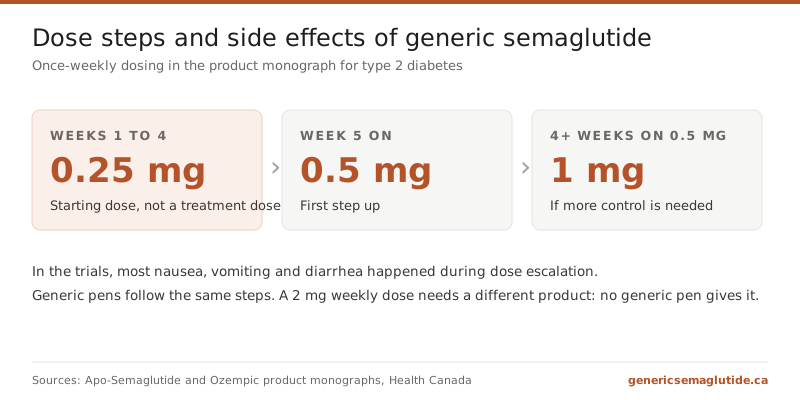
Most stomach side effects happen while the dose is climbing. The monographs say “the majority of the nausea, vomiting and diarrhea events occurred during dose escalation”, and that most events were short.1,2
The monograph builds in a slow start. It sets the first dose at 0.25 mg once a week, and says this dose “is not a therapeutic dose”.1
After 4 weeks, the dose goes to 0.5 mg weekly. After at least 4 more weeks, it may rise to 1 mg if blood sugar is still not controlled well enough.1,2
Your prescriber decides each step; never change your dose on your own.
A few other patterns from the monographs:
- Dizziness can happen early, during dose increases. The monograph says to avoid driving or using machines if you feel dizzy.1
- Lower body weight was linked to more stomach side effects in the trials.1
- Higher doses bring a little more. In a trial of 1 mg vs 2 mg, stomach problems were reported in 30.8% and 34.0% of people.1 No generic pen delivers 2 mg, so this matters only if you move to brand Ozempic.
- Fluids matter. Nausea, vomiting and diarrhea can cause dehydration, and the patient leaflet says to drink plenty of fluids.1
Serious generic Ozempic side effects to know
The Canadian monographs list the same serious risks for the generic and the brand.1,2 Most people never get them, but knowing the warning signs helps you act fast.
Thyroid tumour warning
Both monographs open with a boxed warning. Semaglutide caused thyroid C-cell tumours in rats and mice, and it is not known whether it does this in people.1,2
People with a personal or family history of medullary thyroid cancer, or a condition called MEN 2, should not use it. Tell your doctor about a lump or swelling in your neck, hoarseness, trouble swallowing or shortness of breath.1
Pancreatitis
The patient leaflet lists an inflamed pancreas (pancreatitis) as uncommon. In the blood sugar trials it was confirmed in 7 people on semaglutide, or 0.3 cases per 100 patient-years.1
The warning sign is severe stomach pain that does not go away, and the leaflet says to see a doctor straight away if that happens.1
Gallbladder problems
Gallstones and an inflamed gallbladder have been reported with this class of drugs.1 In the pooled trials, gallstones showed up in 1.1% of people on 1 mg, against 0.5% in the comparison groups.1
Low blood sugar with other diabetes drugs
The risk of low blood sugar goes up when semaglutide is taken with insulin or a sulfonylurea.1 When added to basal insulin, documented low blood sugar with symptoms occurred in 29.8% of people on 1 mg, against 15.2% on placebo.1
The monograph says your prescriber may lower your insulin or sulfonylurea dose when you start.1 Warning signs listed in the leaflet include cold sweat, shaking, a fast heartbeat, confusion and strong hunger.1
Kidney problems from dehydration
Losing fluids through vomiting or diarrhea can strain the kidneys. The monographs describe reports of sudden kidney failure in people on this class of drug, mostly in those who had nausea, vomiting, diarrhea or dehydration.1,2 Some of those reports involved people with no known kidney disease.
Eye problems in people with diabetic retinopathy
A fast improvement in blood sugar control can briefly worsen diabetic eye disease.1 In the two-year SUSTAIN-6 trial of 3,297 people, eye complications happened in 3.0% on semaglutide and 1.8% on placebo, and more than 80% of those with an event already had retinopathy.1,4
A very rare eye-nerve problem called NAION can also cause sudden vision loss.1
Severe allergic reactions
Anaphylaxis and angioedema are rare but serious.1 Signs include trouble breathing, swelling of the face, lips, tongue or throat, trouble swallowing and a fast heartbeat.
Other warnings in the monograph
- Surgery and sedation: food or liquid from the stomach has reached the lungs in some people under general anaesthesia or sedation. Tell the care team you take semaglutide before any procedure.1
- Bowel blockage: cases of ileus and intestinal obstruction have been reported after approval.1
- Heart rate: semaglutide raised average heart rate by 1 to 6 beats per minute in trials.1
- Pregnancy: the monograph says it should not be used in pregnancy, and should be stopped at least 2 months before a planned pregnancy.1
Are generic Ozempic side effects worse than the brand?
No published evidence says they are. The side-effect numbers in the generic monograph are the same as Ozempic’s because they come from the same trials.1,2
The Apo-Semaglutide monograph even labels its trial section “Clinical Trials – Reference Biologic Drug”, meaning the Ozempic studies.1 The Dr. Reddy’s monograph prints the identical side-effect table.3 Neither company has published a study comparing side effects of its product with Ozempic in patients.
What Health Canada did check is the product itself. It says its review of a generic checks that any differences from Ozempic “do not affect the safety, efficacy, or quality” of the drug.5
The main difference is manufacturing: the generics are made by chemical synthesis, while Ozempic is made by a biological process in yeast.6,7,2
The two monographs are not word-for-word twins. The Ozempic one, updated in July 2026, adds “change in skin sensation” as a side effect of unknown frequency, while the May 2026 Apo-Semaglutide monograph does not list it.2,1
Online forums are full of stories about feeling better or worse after a switch. Those are anecdotes, not evidence. A switch often comes with a new pen and a new routine, and those can matter more than the maker.
Pen problems that can feel like side effects
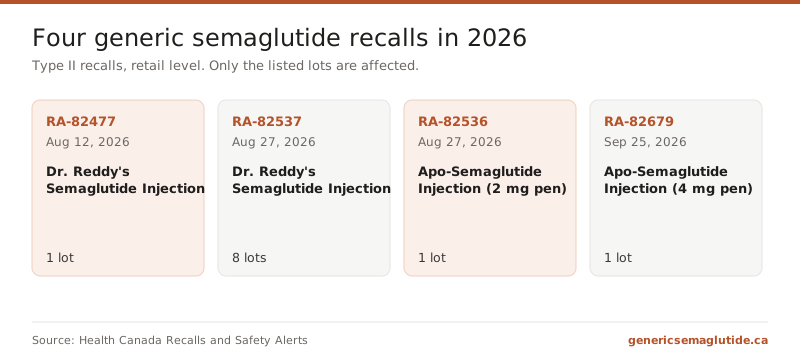
Some generic Ozempic side effects that appear after a switch may come from the pen, not the medicine. Three 2026 recalls involved pens that could give the wrong dose or came in the wrong box.
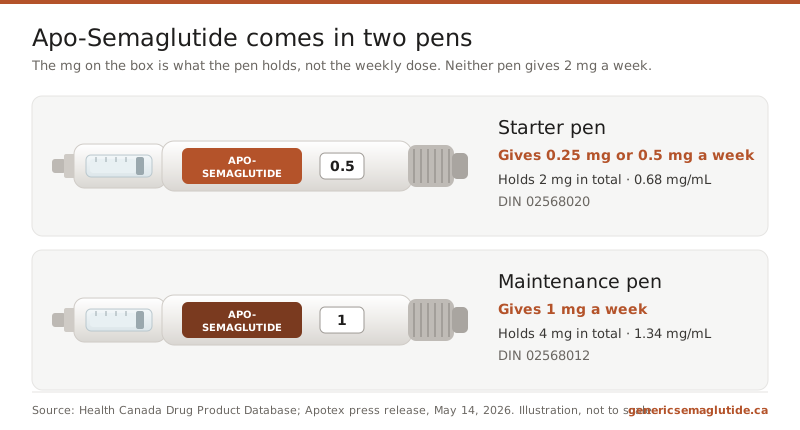
- Apo-Semaglutide 2 mg pen, lot 7000599A (RA-82536): the pen “may display a 2 mg dose in the dose window and deliver a 2 mg dose” instead of 0.25 or 0.5 mg.8 Too much semaglutide most often shows up as nausea; overdoses up to 4 mg in trials mainly caused nausea, and everyone recovered.1
- Apo-Semaglutide 4 mg pen, lot 7000636A (RA-82679): the pen may deliver 0.25 or 0.5 mg instead of 1 mg.9 Our read: a lower dose than prescribed is less likely to upset your stomach, but it may not control blood sugar as intended.
- Dr. Reddy’s Semaglutide Injection, lot 7000544C (RA-82477): a 4 mg pen was packed in a box labelled as the 2 mg pen.10 The two pens are meant for different dose steps.
Check your pen before each dose
The Apo-Semaglutide starter pen “can dial up to a maximum of 0.5 mg”, so a 2 mg reading in its window is a red flag.1 The monograph says to read the dose counter and the pointer, not to count clicks, and to check the flow with each new pen.1
Think you took too much? The monograph says to contact a health professional, an emergency department, a poison control centre or Health Canada’s line at 1-844-764-7669 right away, even without symptoms.1 Every lot and notice is listed on our semaglutide recalls page.
Switching from Ozempic to the generic without new side effects
The dose steps in the generic monograph match Ozempic’s.1,2 Our read: since a switch is not a dose increase, the burst of stomach side effects tied to stepping up is less likely to repeat.
A few habits help the first weeks go smoothly:
- Keep the dose your prescriber wrote. Ask your pharmacist to confirm the new box matches it.
- Learn the new pen. Apotex describes its instructions for use as consistent with the brand’s, yet the pen itself can still look different.11 Ask for a quick demo at the counter.
- Do the flow check. Do it before the first dose from each new pen, as the monograph instructs.1
- Store it right. Keep unused pens in the fridge, never frozen. A pen in use lasts 8 weeks, either in the fridge or between 15 and 30°C.1
- Note anything new. Write down what you feel and when, so your pharmacist can help sort pen issues from side effects.
Our Apo-Semaglutide guide has the DINs and pen details for Apotex’s product.
Reporting generic Ozempic side effects in Canada
You can report any suspected side effect to Health Canada’s Canada Vigilance Program. Both monographs give the same two routes.1,2
- Online, by mail or by fax: through the reporting page at canada.ca/drug-device-reporting.
- By phone: toll-free at 1-866-234-2345.
Health Canada says anyone can report, and that you should report “even if you are not sure” the product was the cause.12
It usually takes more than one report to flag a possible problem, and even then a flag is not proof. When the evidence holds up, Health Canada can change a product’s label or take it off the market.12
Have your pen box handy when you report. The product name, DIN and lot number help tell a pen problem apart from a drug reaction.
Keep in mind that the Canada Vigilance Program “does not provide medical advice”, so call your pharmacist or doctor too.1
When to call your pharmacist or doctor about side effects
Most stomach side effects are mild and fade. Some symptoms need help today, and some just need a call.
Get immediate medical help for any of these, which the patient leaflet flags as serious:1
- Severe stomach pain that will not go away
- Signs of severe low blood sugar: confusion, seizures or passing out
- Trouble breathing, or swelling of the face, lips, tongue or throat
- Sudden loss of vision or blurred vision
Call your pharmacist or prescriber soon if you have:
- Nausea, vomiting or diarrhea that does not settle, or signs of dehydration
- Changes in your eyesight, if you have diabetic eye disease1
- A lump in your neck, hoarseness or trouble swallowing1
- A pen that shows the wrong dose, or a lot number on a recall list
- Any new symptom after switching brands
Outside those emergencies, do not stop on your own. The monograph warns that blood sugar may rise if you stop without talking to your doctor.1 If cost is part of the reason you switched, our generic semaglutide price page and route finder show where the generic is cheapest.
Frequently asked questions
Are generic Ozempic side effects worse than brand Ozempic?
There is no published evidence that they are. The Apo-Semaglutide and Ozempic product monographs print the same side-effect rates, taken from the same Ozempic trials, and Health Canada checked that the generic's differences do not affect safety. If something new starts after a switch, check the pen, the dose and the lot number, and talk to your pharmacist.
How long do the stomach side effects last?
The monographs say most stomach side effects were short and that nausea and diarrhea usually go away over time. Most nausea, vomiting and diarrhea in the trials happened while the dose was being raised. Talk to your pharmacist or prescriber if they do not settle.
What are the side effects of Apo-Semaglutide?
They are the same as Ozempic's. Nausea and diarrhea are very common, affecting more than 1 in 10 people, and vomiting, constipation, stomach pain, indigestion, headache, tiredness and dizziness are common. Serious but less frequent effects include pancreatitis, rated uncommon, and severe allergic reactions, rated rare.
Why do I feel worse after switching to the generic?
Start with the pen. Two Apo-Semaglutide lots were recalled because they could deliver the wrong dose, and a new pen works a little differently. Check the dose window and the lot number, then call your pharmacist, who can also report the reaction to Health Canada.
How do I report a side effect in Canada?
You can report to Health Canada's Canada Vigilance Program online, by mail or by fax through canada.ca/drug-device-reporting, or by calling 1-866-234-2345. Anyone can report, even if unsure that the medicine caused the problem. The program does not give medical advice, so also call your pharmacist or doctor.
- Product Monograph: Apo-Semaglutide Injection (semaglutide injection), control no. 290796, Apotex Inc. (via Health Canada Drug Product Database), 2026-05-01
- Product Monograph: Ozempic (semaglutide injection), submission control no. 305296, Novo Nordisk Canada Inc. (via Health Canada Drug Product Database), 2026-07-13
- Product Monograph: Semaglutide Injection (Dr. Reddy's), control no. 279513, Dr. Reddy's Laboratories Ltd. (via Health Canada Drug Product Database), 2026-04-28
- Semaglutide and Cardiovascular Outcomes in Patients with Type 2 Diabetes (SUSTAIN-6), New England Journal of Medicine (Marso SP et al.), via PubMed, 2016-11-10
- Canada becomes the first G7 country to approve a generic version of semaglutide, Health Canada (news release), 2026-04-28
- Canada clears generic Ozempic production, but pharmacies won't stock it immediately, The Canadian Press (via BNN Bloomberg), 2026-01-02
- Novo Nordisk considers competing with generics through renamed lower-price Ozempic, The Canadian Press (via CTV News), 2026-01-07
- Apo-Semaglutide Injection: Incorrect dose display (RA-82536), Health Canada Recalls and Safety Alerts, 2026-08-27
- Apo-Semaglutide Injection: Incorrect dose display (RA-82679), Health Canada Recalls and Safety Alerts, 2026-09-25
- Semaglutide Injection: Incorrect Pen in Package (RA-82477), Health Canada Recalls and Safety Alerts, 2026-08-12
- Apotex launches Apo-Semaglutide Injection, a generic equivalent of Ozempic, in Canada, Apotex Inc. (Cision/Newswire) [press release], 2026-05-14
- Report a side effect of a health product, drug or medical device, Health Canada (Canada Vigilance Program), 2023-09-08
Informational only, not medical advice. Talk to your prescriber or pharmacist before starting, stopping or switching any medication. Prices are cash prices before insurance and change often; confirm with the pharmacy.
Some provider links may earn a referral fee; that never changes the order of our price tables. Medical disclaimer · How we source